Towing Safety Checklist: 10 Things to Inspect Before Every Trip
Most towing problems don't come from bad luck. They come from things that were off before the trailer even left the driveway, a coupler that wasn't fully seated, a wiring connection that corroded over winter, and a lug nut that worked loose after the first kilometre of highway.
This checklist covers the ten inspection points that matter most before any trip. It takes less than 15 minutes, and each one is something you can check yourself without special tools.
1. Coupler Latch: Seated, Locked, and Pinned
The coupler is the connection point between your trailer and your hitch ball. Before every trip, lower the coupler onto the ball, close the latch fully, and tug up on the trailer tongue. The latch should snap positively into position and hold: no movement, no rattle.
Once closed, insert the coupler pin or lock through the latch mechanism. The pin is what prevents the latch from bouncing open on rough road. Skipping it is one of the most common pre-trip oversights.
Check the ball-socket opening while you're there. If you feel side-to-side slop with the coupler locked on a correctly sized ball, the socket is worn. A worn socket can appear functional at low speed but fail at highway load. Details on coupler sizing, latch types, and when to replace are covered in our guide to trailer couplers.
2. Hitch Ball and Ball-Mount Hardware
With the coupler removed or before hitching up, check the hitch ball itself. It should be clean, round, and free of cracks or flat spots from previous trips. The ball nut underneath must be torqued tight; a ball that spins in the shank or pulls free under load has caused trailer separations.
Check the ball mount shank for any visible bending or deformation, particularly if you tow heavily or have had a hard stop in the past. Confirm the ball mount is fully seated in the receiver and the hitch pin is inserted and clipped.
For travel trailers over roughly 6,000 lbs., check your weight distribution head and spring bars as well. The bars should be at the same tension on both sides, and the head should sit level. Our guide to choosing the right trailer hitch covers when weight distribution is needed and what to look for when setting it up.
3. Safety Chains: Crossed and Clipped
Safety chains are the backup connection if the coupler ever fails. They must be crossed underneath the tongue in an X pattern; this configuration cradles the tongue if it drops, preventing it from digging into the road. They must be short enough to have limited slack but long enough to allow turns without binding.
Check every link in both chains for corrosion, bending, or elongation. A chain with a cracked or heavily rusted link should be replaced before the trip, not after. Confirm the clips or hooks are fully engaged and locked. S-hooks must be closed and pinned; carabiner-style clips must be locked.
In New Brunswick and across Atlantic Canada, road salt and coastal humidity accelerate chain corrosion faster than in drier climates. A visual check each trip and a full replacement every few seasons is a reasonable maintenance schedule.
4. Trailer Lights and Wiring Connection
With the vehicle running, walk around the trailer and have someone step on the brake while you check from behind. You need to confirm:
- Brake lights on both sides
- Turn signals on both sides (left and right)
- Running lights along the sides and rear
- Reverse lights if the trailer has them
Then check the plug connection at the vehicle. Push it fully into the socket and confirm it's locked or clipped. A loose plug can interrupt ground contact and make lights flicker or cut out at speed. Dielectric grease on the connector pins prevents corrosion, one of the most common causes of intermittent light failure after a season of storage.
If a light is out, the fix is usually a bulb or a wiring connection rather than a full harness. We carry trailer lighting parts and trailer wiring accessories for quick fixes before you leave.
5. Tire Pressure on All Four Corners
Check tire pressure on both the trailer and the tow vehicle before every trip, using a reliable gauge. Do this when the tires are cold; pressure that's checked after driving will read higher and give a false reading.
Trailer tire pressure is listed on the tire sidewall, not in the tow vehicle manual. The sidewall shows the maximum cold inflation pressure for that tire's load rating. Towing at or near the sidewall rating is generally correct for trailers at their rated capacity.
Underinflated tires run hotter and are more prone to blowouts. A trailer tire blowout at highway speed can cause severe sway. Overinflated tires reduce the contact patch and can cause bouncing on rough roads, which increases the chance of load shift.
While you're checking pressure, inspect the tread and sidewalls on each tire. Look for cracks, bulges, embedded objects, or uneven wear. Atlantic Canada's spring pothole season is hard on trailer tires. If there's any doubt about a tire's condition, replace it before the season starts, not mid-trip.
6. Wheel Bearings: A Quick Spin Check
Grab each trailer wheel at 9 and 3 o'clock and try to rock it side-to-side. Then grab it at 12 and 6 and try again. Any looseness in either direction indicates worn or improperly adjusted wheel bearings.
Spin each wheel by hand. It should rotate smoothly and quietly. Grinding, roughness, or any resistance suggests bearing wear or contamination. A wheel that spins freely but wobbles slightly when you try to rock it is showing early bearing play.
Wheel bearings should be repacked or replaced according to your trailer manufacturer's schedule, typically annually or every 3,000–5,000 km. For Atlantic Canada owners who store trailers over winter and then launch straight into heavy use in June, a pre-season bearing check is worth doing every year without exception.
7. Brake Controller and Electric Trailer Brakes
If your trailer has electric brakes, turn the brake controller on and check that it powers up with no fault codes or warning lights. Set the sensitivity (gain) to your typical load level; the controller should engage the trailer brakes proportionally with your tow vehicle, not lag behind or lock up.
Do a low-speed test in an empty area: at about 15 km/h, apply the brakes normally and check that the trailer brakes feel like they're contributing to the stop. A controller that's set too low will let the trailer push the vehicle; one set too high will grab and jerk.
Check the breakaway cable; this is the thin cable that clips to the tow vehicle's hitch or frame and pulls the breakaway switch on the trailer if the trailer separates. The clip must attach to the vehicle, not the hitch ball or ball mount, which would travel with the trailer. Test the battery in the trailer's breakaway unit each season, as it needs enough charge to hold the brakes for at least 15 minutes.
8. Load Distribution and Tongue Weight
Tongue weight is the downward force the trailer exerts on the hitch ball. It should be approximately 10–15% of the total loaded trailer weight. Too little tongue weight causes trailer sway. Too much tongue weight overloads the rear axle of the tow vehicle and lifts the front wheels, reducing steering response and extending braking distances.
Proper load distribution in a trailer puts roughly 60% of the cargo weight forward of the trailer's axle(s). Heavy items should be placed low and centred. If you've reloaded or shifted gear since the last trip, recheck that the distribution hasn't changed.
A noticeably nose-high tow vehicle, when the trailer is attached, indicates either low tongue weight or a rearward shift in the load. Both issues can be corrected before you leave.
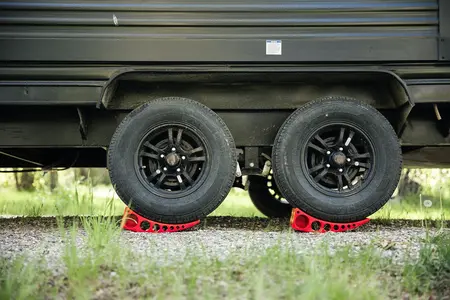
9. Wheel Chocks, Stabilisers, and Jacks Retracted
Before pulling away, walk around and confirm that every stabilizing jack and levelling block is fully retracted and secured. A stabilizer jack left partially down can catch on a curb or dip, tear out of the trailer frame, or create a severe hazard when the trailer begins to turn.
Wheel chocks must be removed from in front of and behind the wheels before moving. If you're leaving a campsite where the trailer was unhitched and re-hitched, this one gets missed more often than you'd think.
We carry a range of wheel chocks sized for trailer and RV tires; they're a simple item with a real safety function when the trailer is parked.
10. A Final Walk-Around
The last step is a full slow walk around the entire rig before pulling onto the road. This is when you catch the things the numbered checks missed: a slide-out that's still partially open, a compartment door that wasn't latched, a bike rack that shifted, and an awning arm that wasn't retracted.
Walk the driver's side from front to back, walk across the rear, and walk the passenger side from back to front. Look at the roofline on your way around to confirm nothing is catching air or is out of position.
Get on the road slowly and stop after the first kilometre to check that everything is still settled and that no unusual sounds have appeared. Highway vibration reveals things that a driveway check does not.
Frequently asked questions
What should I check before towing?
The most critical checks before any towing trip are coupler fully seated and pinned, hitch ball nut torqued tight, safety chains crossed and clipped, all trailer lights working, tire pressures correct on the trailer and tow vehicle, wheel bearings with no play, and brake controller powered on and calibrated. A full 10-point walkaround takes under 15 minutes and catches the items most likely to cause a roadside problem or accident.
What is the 60/40 rule in trailering?
The 60/40 rule refers to load distribution inside the trailer: approximately 60% of the cargo weight should be positioned in the front half of the trailer (ahead of the axle), and 40% in the rear half. This keeps enough weight on the tongue to maintain stability without overloading the hitch ball or tow vehicle's rear axle. It applies primarily to enclosed trailers, flatbeds, and utility trailers where you control load placement; travel trailers with fixed furniture don't require active 60/40 management but should still have heavy items stored low and forward.
What is the 80/20 rule for towing?
The 80/20 rule is a practical capacity guideline: don't tow a trailer with a loaded weight above 80% of your tow vehicle's rated maximum towing capacity. This leaves a 20% margin for variations in load, road conditions, grades, and the combined weight of passengers and gear in the tow vehicle. Towing at 100% of rated capacity leaves no safety buffer for unexpected conditions, particularly on the hilly terrain common on New Brunswick highways and throughout Atlantic Canada.
If any of these checks turns up something that needs replacing before your next trip, we carry hitch hardware, trailer lighting, wiring connectors, wheel chocks, and coupler parts at 745 Route 133, Boudreau-Ouest, New Brunswick. Call us at (506) 532-5947 or browse what we carry at thetrailerguys.ca.
Recent articles
View all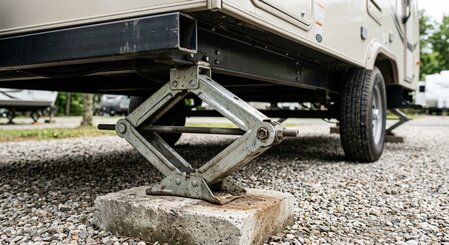
Scissor Jacks vs Stabilizer Jacks: Which Does Your Trailer Need?
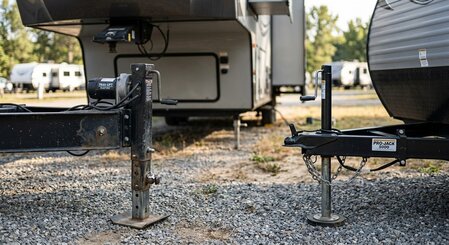
5th Wheel & A-Frame Trailer Jacks Explained