Trailer Couplers Explained: How to Choose, Install, and Maintain Yours

The coupler is the single point of contact between your trailer and your tow vehicle. Get it wrong, and the consequences range from a misaligned tow to a trailer separating at highway speed. Yet for most RV owners, the coupler remains a low priority until something goes wrong.
This guide covers what different coupler types are designed for, how to pick the right one for your setup, how installation works, and what maintenance looks like through Atlantic Canada's seasons.
What Does a Trailer Coupler Do?
The coupler is a steel housing mounted to the front of your trailer's tongue. It clamps down over the hitch ball on your tow vehicle and locks in place, creating the pivot point that lets the trailer follow your vehicle through corners. It also transfers the trailer's tongue weight forward onto the tow vehicle, which is why getting the size and rating right matters.
Most couplers have three main parts: the ball socket (the cup that fits over the ball), the body (welded or bolted to the tongue), and the latch mechanism (the part you open and close when hooking up).
Types of Trailer Couplers
Not all trailers use the same coupler. The shape of your trailer's tongue determines which style fits.
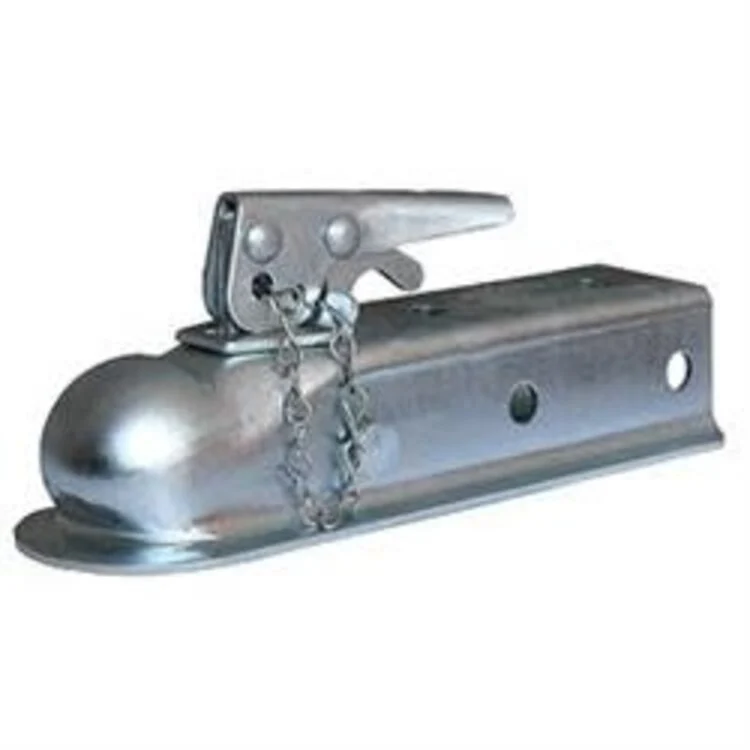
Straight-tongue couplers are the most common type. They mount to a single square or round steel tube and work on light-to-medium trailers, including most boat trailers, utility trailers, and smaller campers. If your trailer has a single straight tongue frame rail running to the front, this is your coupler type.
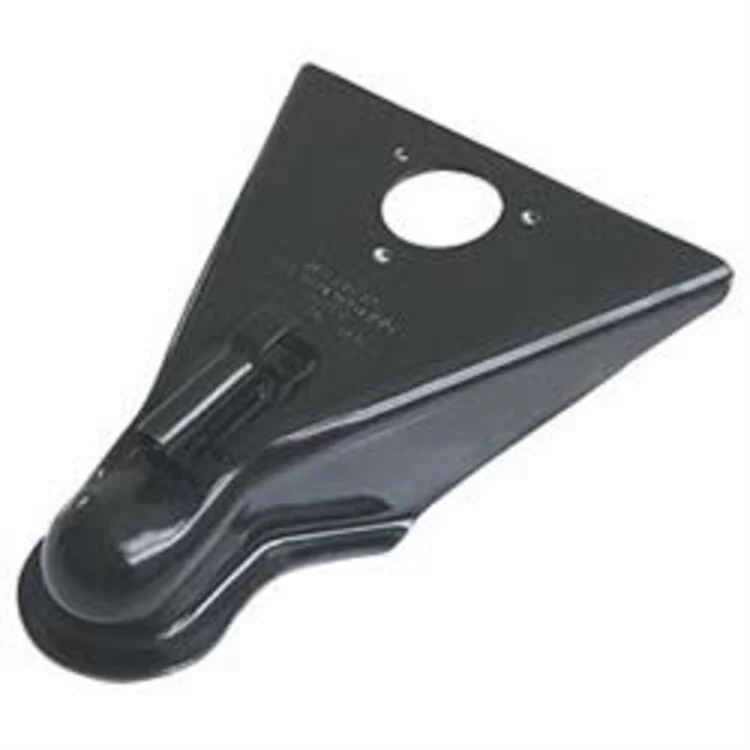
A-frame couplers bolt to trailers with a triangular front section, where two frame rails converge to a point. This design spreads the load across a wider base and provides better stability for heavier trailers. The coupler type that most RV owners in Atlantic Canada deal with on a daily basis is the A-frame tongue, which is used in the majority of travel trailers and larger RV camping trailers.
Channel-mount (adjustable) couplers slide up and down a vertical channel, letting you raise or lower the coupler height to keep the trailer level. They suit situations where one trailer is towed by different vehicles with varying hitch heights.
Specialty types, such as fifth wheel, gooseneck, and pintle couplers, are built for heavy commercial loads and are outside the scope of typical RV and camping trailer use.
Browse our full range of trailer couplers to see the A-frame, straight-tongue, and adjustable options we carry.
How to Choose the Right Coupler
Three numbers drive this decision.
Gross trailer weight (GTW): Every coupler has a weight rating stamped on the body. That rating must meet or exceed your trailer's GVWR. Using an underrated coupler risks failure under load, and Transport Canada's towing regulations require that all towing components be rated appropriately for the load.
Ball size: The three most common ball diameters are 1-7/8", 2", and 2-5/16". A trailer rated under 3,500 lbs. typically uses a 1-7/8" or 2" ball. Most travel trailers and heavier utility trailers use 2-5/16". The size is stamped on the coupler body. If the ball diameter and coupler opening don't match, the connection will either be too loose or won't close at all.
Tongue height: The coupler sits 3 to 6 inches above the trailer frame depending on the mounting. Match it to your tow vehicle's hitch receiver height so the trailer rides level. A trailer that tips nose-down puts excess tongue weight on the hitch ball and ball mount; one that tips tail-down reduces stability at speed.
Latch type is mostly a usability and security preference. The standard posi-lock latch uses a manual lever and works reliably with routine lubrication. Sleeve-lock latches enclose the ball with a collar for extra security on heavy loads. No-latch (QuickPin) styles have no moving lever parts and instead use a pin, which makes them highly reliable but slightly slower to hook up.
How to Install a Trailer Coupler
Most replacement couplers bolt on with four bolts through the trailer tongue. Welded couplers are more permanent and are typically replaced by a welder or trailer shop.
For a bolt-on installation:
- Remove the old coupler by unbolting it from the tongue. Note the number of bolt holes and their spacing, as replacement couplers need to match.
- Confirm that the replacement coupler's tongue width (the internal width of the channel that slides over the tongue) matches the frame dimension of your trailer.
- Thread new bolts by hand first to confirm alignment, then torque to the coupler manufacturer's specification. Most bolt-on couplers require 50-75 ft-lbs of torque on 1/2" grade 5 hardware.
- Test the fit by lowering the coupler onto your hitch ball, closing the latch, and pulling up firmly on the trailer tongue. There should be no movement.
- Insert a coupler pin or lock through the latch opening to prevent it from accidentally opening while driving.
If you doubt the coupler is rated for your trailer or positioned correctly on the tongue, have a shop confirm it before your first trip. A five-minute check at 745 Route 133, Boudreau-Ouest, is worth it.
How to Maintain Your Trailer Coupler
A coupler that isn't maintained gets stiff, corrodes, and eventually fails to lock properly. Atlantic Canada's weather, road salt, and coastal humidity accelerate that process.
Lubricate the ball socket and latch mechanism at least twice per season, and after any time the trailer sits outside in the rain or near salt air. Trailer ball grease or general-purpose marine grease works well in the socket. The latch pivot should get a spray of penetrating oil or white lithium grease.
Inspect the ball socket for wear. The inside of the cup wears over time, especially if the ball size and coupler size were never a precise match. If you feel noticeable side-to-side slop when the coupler is closed over the ball, the socket is worn, and the coupler should be replaced.
Check the latch each trip. Open and close it before hooking up. It should move smoothly, snap fully into position, and stay locked when you tug up on it. A latch that won't stay locked is a replacement job, not a "one more trip" situation.
Before winter storage, clean off road salt and grit, grease the socket generously, and leave the latch open so the internal spring doesn't stay compressed for months at a time. A coupler pin can stay in place through storage to keep moisture and debris out of the latch cavity.
A proper pre-departure inspection covers the coupler along with every other towing component. Our towing safety checklist walks through the full set of checks worth doing before every trip.
When to Replace Your Coupler
Replace your coupler if you notice any of these:
- Cracked or visibly deformed ball socket
- Latch that won't close fully or won't stay locked
- Corrosion that has gone through the body wall (surface rust is manageable; structural rust is not)
- Side-to-side slop of more than 1/8" when locked on a correctly-sized ball
- Damage from a hard impact or collision
A coupler repair kit can address latch wear in some cases, replacing just the spring and latch hardware without pulling the full coupler body. If the socket is worn or the body is compromised, replace the entire coupler. You can find repair kits and complete replacement couplers in our trailer couplers collection.
Frequently asked questions
What are the different types of trailer couplers?
The main types are straight-tongue (for single-rail trailer frames), A-frame (for trailers with a triangular tongue, including most travel trailers), and channel-mount (adjustable height for multi-vehicle setups). Within those, latch styles vary: posi-lock, sleeve-lock, and no-latch (QuickPin) are the most common for everyday RV and utility trailer use. Fifth wheel and gooseneck setups are separate categories built for heavy commercial loads.
How do I know what size trailer coupler I need?
Check your trailer's GVWR and match it to a coupler with an equal or higher weight rating. Then confirm the ball size: look for the ball diameter stamped on your existing coupler or on your tow vehicle's hitch ball. The two most common sizes are 2" and 2-5/16". If you're not sure, bring the trailer in and we can confirm the right fit at our shop at 745 Route 133, Boudreau-Ouest, New Brunswick.
How do I choose the right trailer coupling?
Match the coupler style to your trailer's tongue shape, select a weight rating that meets or exceeds your GVWR, confirm the ball size matches your vehicle's hitch ball, and choose a latch type that suits how often and where you tow. For most RV travel trailers, an A-frame coupler with a 2-5/16" ball opening and a posi-lock or sleeve-lock latch is the right combination. For more information, see our guide on How to Choose the Right Trailer Hitch.
Ready to sort out your coupler before the next trip? Browse our trailer couplers online or stop in at 745 Route 133, Boudreau-Ouest, New Brunswick. For questions about what fits your specific trailer, give us a call at (506) 532-5947.
Recent articles
View all
Scissor Jacks vs Stabilizer Jacks: Which Does Your Trailer Need?
5th Wheel & A-Frame Trailer Jacks Explained