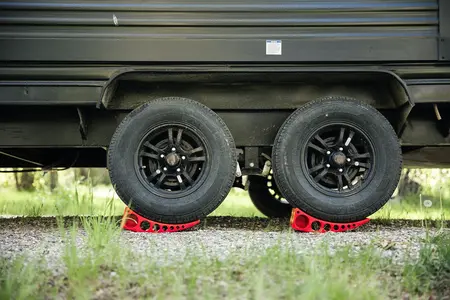
RV Wheel Chocks Buying Guide: Size and Type
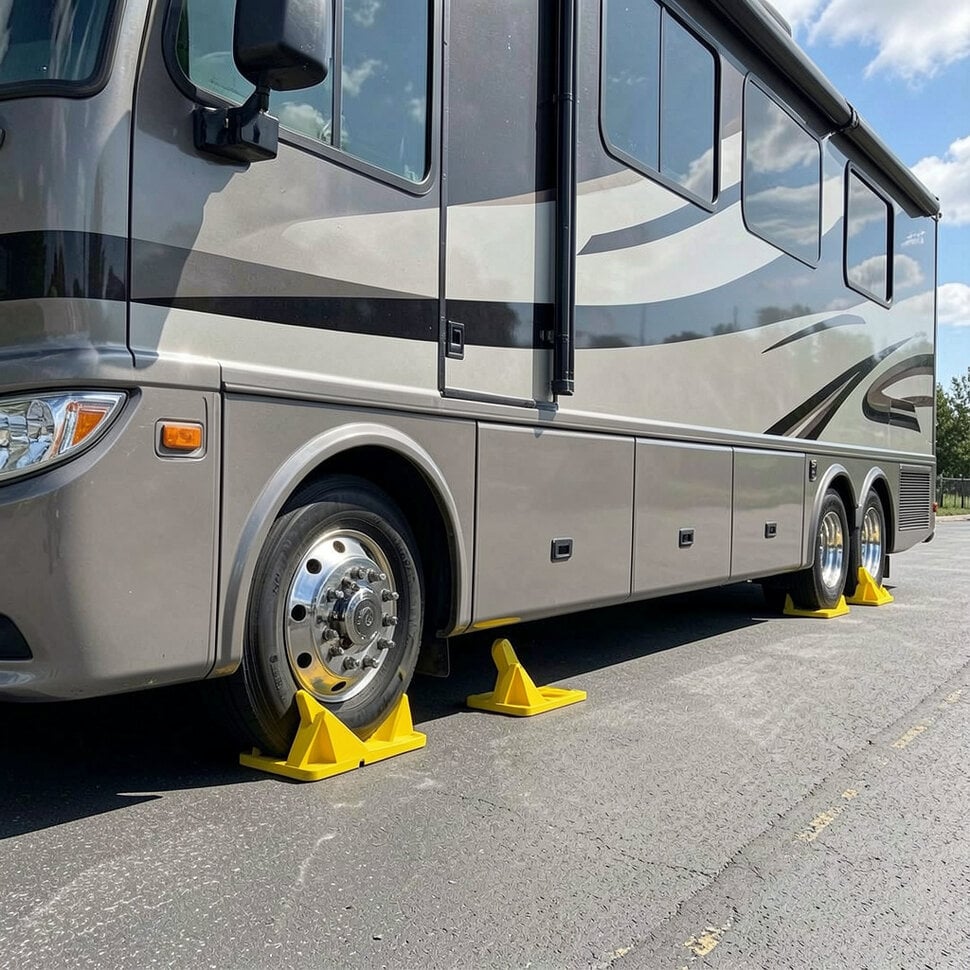
Picking the right RV wheel chocks comes down to two questions: what size fits your tires, and which type matches how your trailer is built. Get either one wrong and you end up with a chock that slides, cracks, or simply does not do its job. This guide walks through both, plus the materials and placement habits that keep your rig from rolling while you are hooked down for the night.
Why Every Travel Trailer and Fifth Wheel Needs Wheel Chocks
Tow vehicles have a parking brake and a transmission holding them in place. Travel trailers, fifth wheels, and other towables do not. Once you unhitch, the only thing stopping your trailer from creeping forward or backward is a wheel chock wedged against the tire.
Chocks should go down before you disconnect from the tow vehicle, and they should stay in place until you are ready to hitch back up. They also matter while loading a toy hauler, since the shifting weight of cargo can nudge a trailer that is not chocked. For a broader pre-trip and post-setup routine, our towing safety checklist covers the other steps worth running through before you leave the driveway.
The Three Main Types of RV Wheel Chocks
Standard wedge chocks sit on the ground in front of and behind a tire. They are the simplest option and work on any single-axle or tandem-axle trailer. Our Chock R Dock from Tri-Lynx is a good example: a single copolymer polypropylene wedge that doubles as a tongue dock.
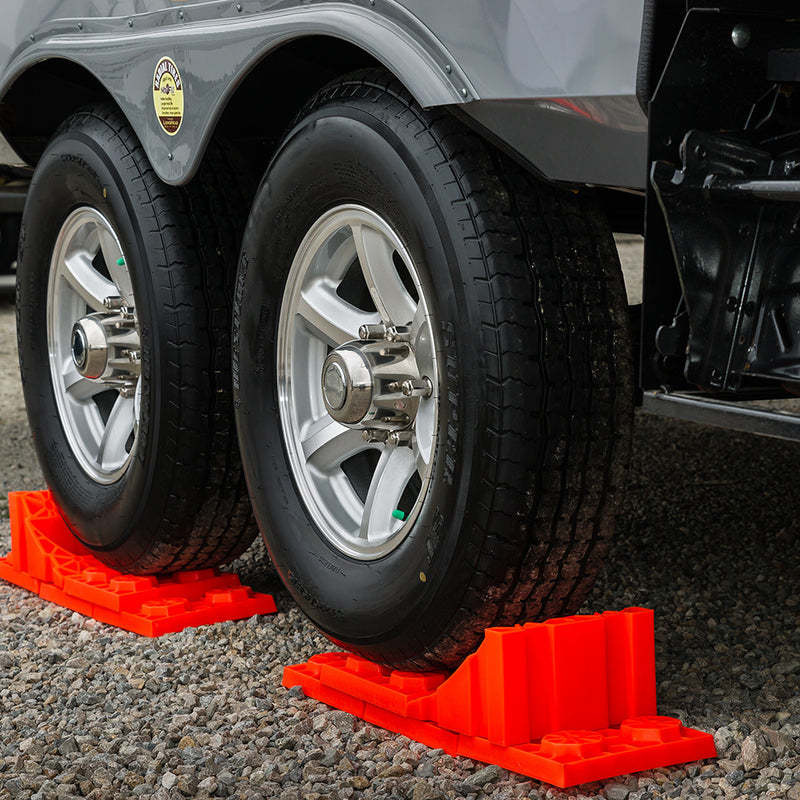
X-chocks are built for tandem-axle trailers. The chock fits in the gap between the two tires on one side and expands outward until it presses against both, which cuts down on the front-to-back rocking you feel walking around inside a parked trailer. They will not stop the trailer from rolling on their own, so most owners pair them with a standard chock or their parking brake.
Our T-Chock 2-Pack with Wrench from Stromberg Carlson fits tires spaced 2 to 17 inches apart and includes a wrench for adjustment.
Locking wheel chocks add a security layer on top of the basic rolling prevention. These are usually metal, include a padlock point, and double as a theft deterrent since a locked chock makes it much harder to move the trailer without a key.
For everyday RVing, a single-axle trailer usually just needs standard wedge chocks. Tandem-axle trailers benefit most from adding X-chocks to reduce sway once you are parked.
Wheel Chock Materials: Plastic, Rubber, or Metal
Each material trades off weight, cost, and durability differently.
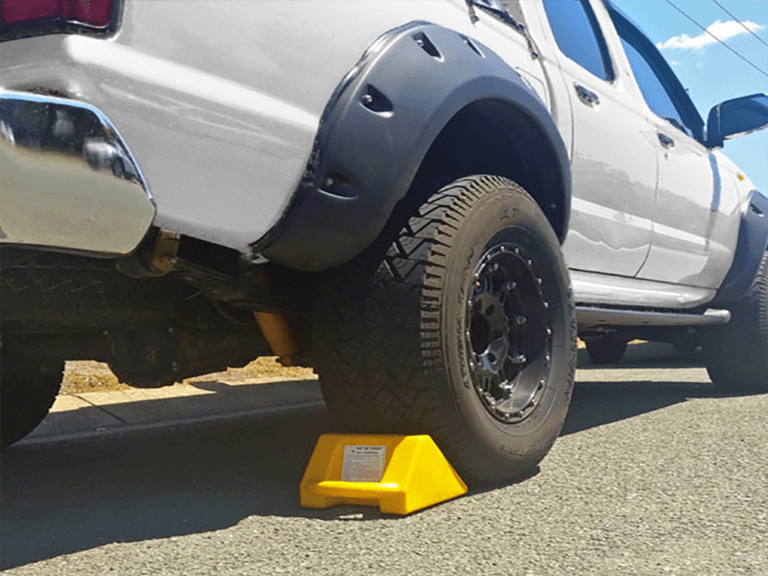
Plastic chocks are the lightest and cheapest option, and they are easy to store in a bumper-mounted holder or storage bay. The tradeoff is durability. Cheaper plastic can crack in cold weather or under repeated use, and smooth plastic bases can slip on gravel or wet pavement.
Rubber chocks weigh more and cost more, but they grip better on asphalt, gravel, and uneven ground. This is the material most RVers land on for chocks that see regular use across multiple seasons.
Metal, usually found on X-chocks and locking chocks, is the most durable option and the only material that supports a built-in lock. The added weight is a fair trade if security or long-term durability matters more than saving a few dollars.
If your current chocks are cracked, worn smooth, or you are stepping up from scrap wood or bricks (which are not designed to hold a trailer's weight and can shift or shatter under load), it is worth replacing them with a properly rated chock in one of these three materials.
How to Size Your Wheel Chocks Correctly
Sizing is the part most people get wrong, and an undersized chock is a real safety gap. A commonly used rule of thumb is that a chock's height should be roughly 25 percent of your tire's diameter. That gives the chock enough surface to create a real barrier against the tread instead of just a speed bump.
Every manufacturer lists a tire size range for their chock, so check that range against your actual tire diameter before buying rather than guessing from the trailer's weight rating. X-chocks are sized differently since they expand to fit the gap between tandem tires. Our T-Chock 2-Pack, for example, adjusts to fit tires spaced 2 to 17 inches apart, so measure the gap between your dual tires before choosing one.
How Many Wheel Chocks Do You Need
At minimum, plan on two wheel chocks for any towable RV. The safest setup nests one tire completely, meaning a chock in front and a chock behind the same tire, which locks that wheel from moving in either direction.
Tandem-axle trailers with X-chocks can often get away with fewer standard chocks since the X-chock is already handling movement between the two axles. Larger rigs or trailers parked on any kind of slope benefit from chocking a tire on each side of the trailer rather than just one.
Placement Tips That Actually Matter
A chock only works if it is seated correctly.
- If you are parked facing downhill, place chocks in front of the tires. If parked facing uphill, place them behind.
- On level ground, one chock in front and one behind the same tire gives you the most security.
- Push the chock in with your foot until it sits snug against the tread. A loose chock that is just sitting near the tire will not stop anything.
- Avoid setting chocks on loose gravel, ice, or anything slick. If the surface will not grip the chock itself, the chock cannot grip the tire.
When to Replace Your Wheel Chocks
Swap out your chocks if you notice cracking, a base that no longer grips, or a locking mechanism that has seized up. It is also worth upgrading if you have outgrown your current chocks, for example moving from a single-axle camper to a tandem-axle trailer that would benefit from X-chocks, or if your spare tire cover has worn out around the same time your chocks have. Our spare tire cover sizing guide walks through matching covers to tire diameter using the same measuring approach.
Frequently Asked Questions
Do RV wheel chocks actually work?
Yes, when sized correctly and placed snugly against the tire tread. A properly rated chock stops a parked trailer from rolling, which matters since towables have no parking brake of their own.
How many wheel chocks do I need for my RV?
Two at minimum, with one in front and one behind the same tire for the most secure hold. Tandem-axle trailers often add X-chocks between the dual tires for extra stability.
What size wheel chocks do I need?
Match the chock height to roughly 25 percent of your tire's diameter, then check the manufacturer's listed tire size range to confirm the fit.
Can I use wood or bricks instead of wheel chocks?
It is not recommended. Scrap wood and bricks are not built to hold a trailer's weight and can shift, crack, or shatter under load, which defeats the purpose entirely.
Do I need X-chocks if I already use standard wedge chocks?
X-chocks solve a different problem: they reduce the front-to-back rocking of a tandem-axle trailer once you are parked. Standard chocks still handle rolling prevention, so many tandem-axle owners run both.
Shop Wheel Chocks at The Trailer Guys
Whether you need a basic set of wedge chocks, a pair of X-chocks for a tandem-axle trailer, or a locking chock for extra security, browse our full range of wheel chocks or explore the rest of our Wheels & Brakes collection for axles, bearings, and hubs. Stop by our shop at 745 Route 133 in Boudreau-Ouest, and our team can help you match the right chock to your trailer's axle setup, or check out our axle and bearing guide if you are due for a wheel-end inspection while you are at it.
```
Recent articles
View all
Scissor Jacks vs Stabilizer Jacks: Which Does Your Trailer Need?
5th Wheel & A-Frame Trailer Jacks Explained