RV & BBQ Propane Regulators: Single-Stage vs Two-Stage
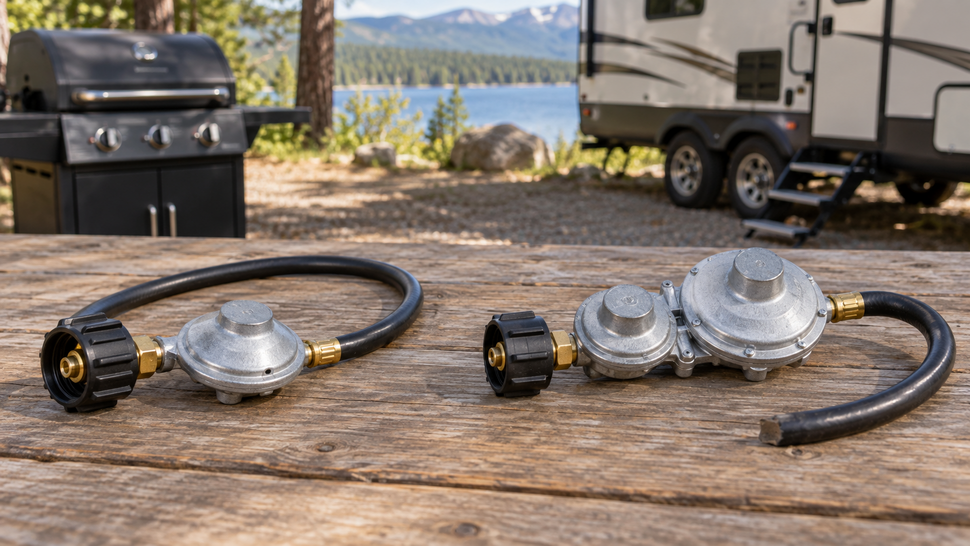
Your RV needs a two-stage propane regulator. Your portable BBQ uses a single-stage one. Both turn high tank pressure into the low pressure appliances can burn, but a two-stage regulator does it in two steps and holds that pressure steady, which your furnace, fridge, and water heater depend on. This guide explains the difference, where auto changeover regulators fit, how to hook up a BBQ safely, and how to tell when a regulator needs replacing.
What a Propane Regulator Actually Does
Pressure inside a propane cylinder is high, and it moves around. It climbs on a hot July afternoon and drops on a cold October night. RV appliances cannot run on that. They are built for a steady low pressure of about 11 inches of water column, which works out to roughly 0.4 psi.
The regulator sits between the tank and the appliances and brings the pressure down to that level. How smoothly it does that is the real difference between single-stage and two-stage designs.
Single-Stage Regulators: Built for BBQs
A single-stage regulator drops tank pressure to appliance pressure in one step. It is simple, compact, and inexpensive, which is why nearly every portable grill ships with one on the end of its hose.
The tradeoff is consistency. As the tank empties or the temperature changes, the outlet pressure drifts a little. A grill does not care. You will not notice a slightly smaller flame while cooking burgers. Our Fairview single-stage grill regulator is a typical example: 1/4 inch inlet, 3/8 inch outlet, set to 11 inches of water column, and rated to 140,000 BTU.
What a single-stage regulator should not do is feed your trailer's gas system.
Two-Stage Regulators: What Your RV Needs
A two-stage regulator splits the job. The first stage brings tank pressure down to an intermediate level of around 10 psi. The second stage takes it the rest of the way to 11 inches of water column. Because the second stage only deals with a small, steady input, the output stays constant whether the tank is full or nearly empty, and whether it is a hot day or a cold one.
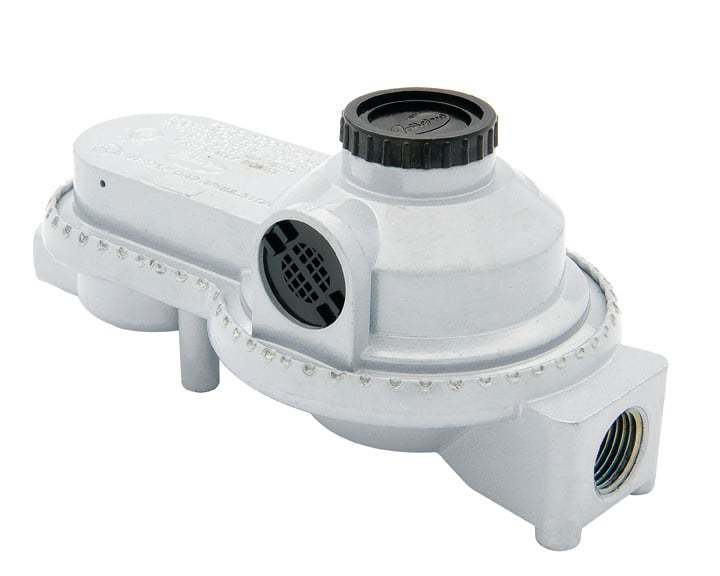
That steadiness is what keeps the furnace lighting, the fridge cooling, and the water heater running without dropping out. Two-stage regulators are the standard on travel trailers and fifth wheels for exactly this reason. The Fairview 2-Stage Regulator we carry has a 1/4 inch FPT inlet and a 3/8 inch FPT outlet, which matches the setup on most trailers.
Single-Stage vs Two-Stage at a Glance
| Single-Stage | Two-Stage | |
|---|---|---|
| Pressure drops | In one step | In two steps (tank to ~10 psi, then to 11 in. WC) |
| Output consistency | Drifts as the tank empties or temperature changes | Stays steady |
| Cold weather | Less reliable | Handles temperature swings better |
| Typical use | Portable BBQs and grills | RV furnace, fridge, water heater, stove |
| Size and cost | Smaller, cheaper | Larger, costs more |
Auto Changeover Regulators for Dual-Tank Trailers
If your trailer runs two tanks on the A-frame, it likely has an auto changeover regulator. This is a two-stage regulator with two inlets and a lever. You point the lever at the tank you want to draw from first. When that tank runs empty, the regulator switches to the reserve tank on its own, so the furnace keeps running at 3 a.m.
Most changeover regulators have an indicator window that changes colour when the service tank is empty. Check your regulator's instructions for the exact colours. When the indicator changes, flip the lever to the full tank, and take the empty one in for a refill. The Fairview Auto Change Over Regulator we stock works this way.
One catch: because the switch happens automatically, it is easy to miss that you are already on your last tank. Glance at the indicator every few days on longer trips.
Hooking a BBQ Up to Your RV
This is where regulators cause the most confusion. The rule is simple: match the pressure to the appliance. There are three common setups.
1. Grill on its own tank. The grill runs off a separate cylinder through its own single-stage regulator. Nothing connects to the RV. This is the simplest option.
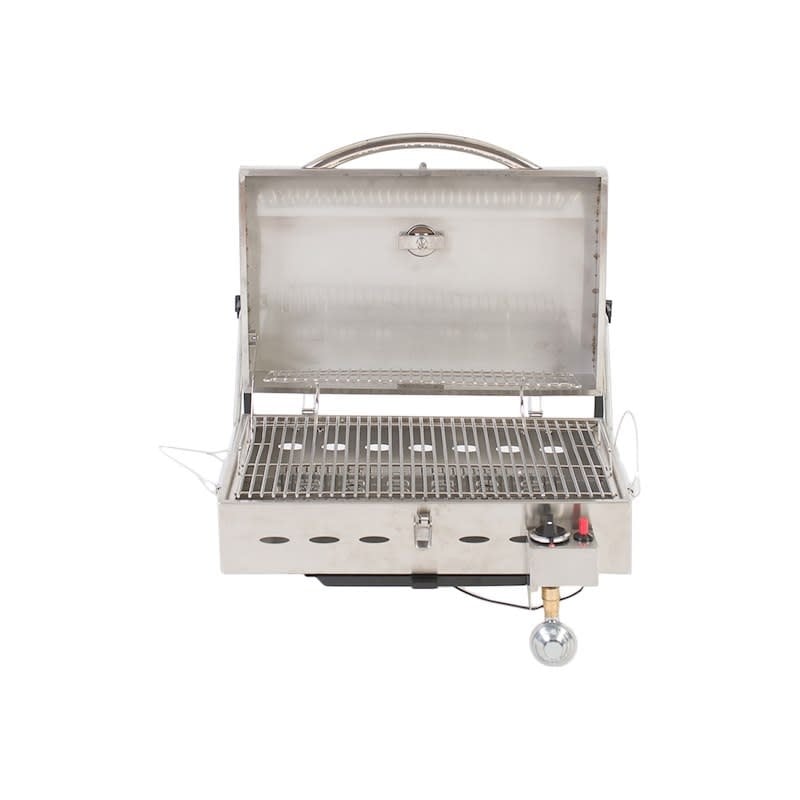
2. Grill on a 1 lb disposable cylinder. Small portable grills, like the Faulkner 12,000 BTU stainless steel BBQ we carry, can run on a disposable canister. The appliance regulator threads onto the canister. Some motorhome owners add a POL Extend-a-Stay tee inline at the tank, which gives a 1"-20 outlet so these appliances can run off the main tank instead of disposable canisters. That outlet is at tank pressure, so it only feeds appliances with their own regulator.
3. Grill on the RV's low-pressure quick-connect port. Many newer trailers have an exterior low-pressure port. Gas coming out of it is already regulated to 11 inches of water column by your two-stage regulator. A grill connected there must be set up for low-pressure supply, which usually means a low-pressure hose or conversion kit from the grill's maker. Do not stack a second regulator in line unless the grill manufacturer says to.
Never connect a high-pressure appliance, like an outdoor burner built for a high pressure regulator, to your RV's low-pressure line.
Signs Your RV Regulator Is Failing
Regulators are mechanical parts with diaphragms and springs inside, and they wear out. Watch for:
- Yellow, lazy, or sooty flames on the stove instead of a crisp blue flame
- Furnace or fridge that lights and then drops out, or a pilot that will not stay lit
- A hissing sound or gas smell at the regulator
- Whining or humming while appliances are running
- Heavy corrosion on the body or fittings
A common guideline is to replace an RV regulator every 10 to 15 years even if it seems fine, since the internal parts age whether or not they fail. If you smell gas inside the trailer, your LP detector should be the first thing to warn you. Our guide to RV propane detectors vs carbon monoxide detectors covers where it should be mounted and when it is due for replacement.
Protecting Your Regulator Through Atlantic Canada Weather
Every regulator has a vent. On a two-stage regulator the larger second-stage vent must point down. If it faces up or sideways, rain can get in, freeze overnight, and block the vent, which throws off the pressure your appliances get. Check the vent direction any time you replace a regulator or bump the rack.
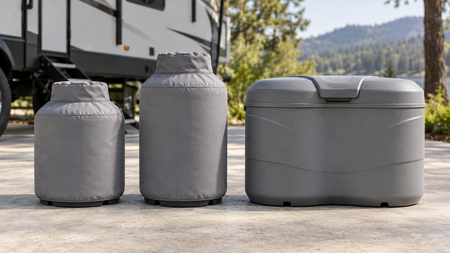
A tank cover does a lot of the work here. It keeps rain, road salt, and snow off the regulator while still leaving the bottom open for ventilation. If you are shopping for one, our propane tank cover sizing guide shows how to measure for single, dual, 20 lb, and 30 lb setups.
What to Check When Replacing a Regulator
- Type. Two-stage for a single tank, two-stage auto changeover for dual tanks.
- Inlet and outlet sizes. Most RV regulators use a 1/4 inch inlet and 3/8 inch outlet. Match your existing lines.
- Outlet direction. Regulators are sold with the outlet in different positions, often described like a clock face, such as 9 o'clock. Matching yours avoids rerouting the gas line.
- Capacity. The regulator's BTU rating should cover all of your appliances running at once.
- Sealing. Use yellow gas-rated thread tape on pipe threads only. Flare fittings and tank connections seal on their own and should never be taped.
- Leak test. With the tank open, brush soapy water on every connection and watch for bubbles before lighting anything.
Propane appliances and installations fall under provincial rules, as the Canadian Propane Association notes. If you are not comfortable doing the swap and the pressure check yourself, bring your trailer to the shop and have it done properly.
Frequently Asked Questions
What type of propane regulator do I need for my RV?
A two-stage regulator set to 11 inches of water column. If your trailer has two tanks, use a two-stage auto changeover regulator so it switches to the reserve tank automatically.
Can I use a BBQ regulator on my RV?
No. A BBQ regulator is single-stage and its output drifts with tank pressure and temperature. Your furnace, fridge, and water heater need the steady pressure a two-stage regulator delivers.
When should I use a two-stage propane regulator?
Any time propane feeds appliances that need steady pressure, including RV furnaces, fridges, water heaters, and ranges. Single-stage is fine for a standalone portable grill.
How often should an RV propane regulator be replaced?
A common guideline is every 10 to 15 years, or right away if you notice hissing, a gas smell, weak or yellow flames, or appliances that keep dropping out.
Why does my propane regulator freeze up?
Frost on the outside during heavy use is normal, since propane cools as it expands. Ice inside the vent is not. It usually means the vent is not pointing down or the regulator is exposed to rain and snow. Turn the vent down and add a tank cover.
Browse our RV propane regulators for Fairview two-stage, auto changeover, single-stage grill, and high pressure regulators. Pick up adapters and yellow gas tape in L/P fittings, check out our RV BBQ for a campsite grill, or shop the full L/P gas parts collection. Not sure which regulator matches yours? Bring the old one to 745 Route 133 in Boudreau-Ouest and we will match it for you.
Recent articles
View all
Propane Tank Cover Sizing Guide: 20lb, 30lb & Dual Setups