How to Choose the Right Trailer Hitch: Ball Mount, Fifth Wheel, or Weight Distribution?
The hitch is the foundation of every tow setup, and picking the wrong one doesn't just slow you down at the campground; it affects braking, sway control, and how much weight your vehicle can safely manage. Yet many RV owners buy whatever came with the truck or grab whatever looks right at the counter.
This guide breaks down the three hitches that matter most for RV and trailer towing in Canada: the ball mount receiver hitch, the fifth wheel hitch, and the weight distribution hitch. By the end, you'll know which one fits your setup and why.
The Receiver Hitch: Your Starting Point
Before getting into ball mounts or fifth wheels, it helps to understand the receiver hitch, the steel assembly bolted to your vehicle's frame that everything else plugs into.
Receiver hitches are rated by class, and that class determines how much you can safely tow.
| Class | Receiver Size | Max GTW | Typical Use |
|---|---|---|---|
| Class I | 1-1/4" | 2,000 lbs. | Bike racks, small cargo carriers |
| Class II | 1-1/4" | 3,500 lbs. | Small utility trailers, lightweight campers |
| Class III | 2" | 8,000 lbs. | Most travel trailers, boat trailers, utility trailers |
| Class IV | 2" | 12,000 lbs. | Heavier trailers, frequent towing |
| Class V | 2-1/2" | 20,000+ lbs. | Commercial and heavy-duty hauling |
Most Atlantic Canada RV owners who pull a travel trailer should start with a Class III or Class IV receiver hitch. The receiver is where the ball mount, weight distribution head, or fifth wheel rail system connects.
Your hitch must be rated at or above your trailer's Gross Trailer Weight (GTW). If you're ever between two classes, go higher; the higher-rated hitch costs marginally more and gives you a meaningful safety margin.
Ball Mount Hitches: The Everyday Workhorse
A ball mount is the removable shank that slides into your receiver hitch and holds the hitch ball your trailer's coupler locks onto. Most travel trailers, boat trailers, and utility trailers connect through a ball mount setup.
When a ball mount is the right choice:
- Your trailer uses a standard A-frame or straight-tongue coupler (the most common setup for travel trailers)
- You're towing a trailer under roughly 6,000–8,000 lbs loaded
- You need a setup that's quick to remove and swap between trailers
What to get right on a ball mount:
Drop or rise: the ball mount must position the hitch ball at the same height as the trailer coupler so the trailer rides level. A trailer nose down by more than an inch puts excess tongue weight on the ball mount and reduces rear-axle traction on the tow vehicle. A trailer nose-up creates sway. Measure the height from the ground to the centre of your receiver opening, then measure the height of your trailer coupler. The difference is the drop or rise you need.
Ball diameter: match the hitch ball diameter to the coupler size stamped on your trailer's coupler housing. The two most common sizes are 2" (for trailers up to roughly 8,000 lbs.) and 2-5/16" (for heavier trailers, typically 6,000–20,000 lbs.). A ball-coupler mismatch that appears to fit can fail under load.
Shank size: Confirm the ball mount shank (the part that slides into the receiver) matches your receiver's opening. A 1-1/4" shank goes into a Class I or II receiver; a 2" shank goes into a Class III or IV receiver. Using an adapter is fine for light-duty use but not recommended when towing at capacity.
If you're unsure what coupler size is on your trailer or what drop you need, our trailer couplers guide walks through how to read the stamp and measure for a fit.
Fifth Wheel Hitches: For the Bigger Rigs
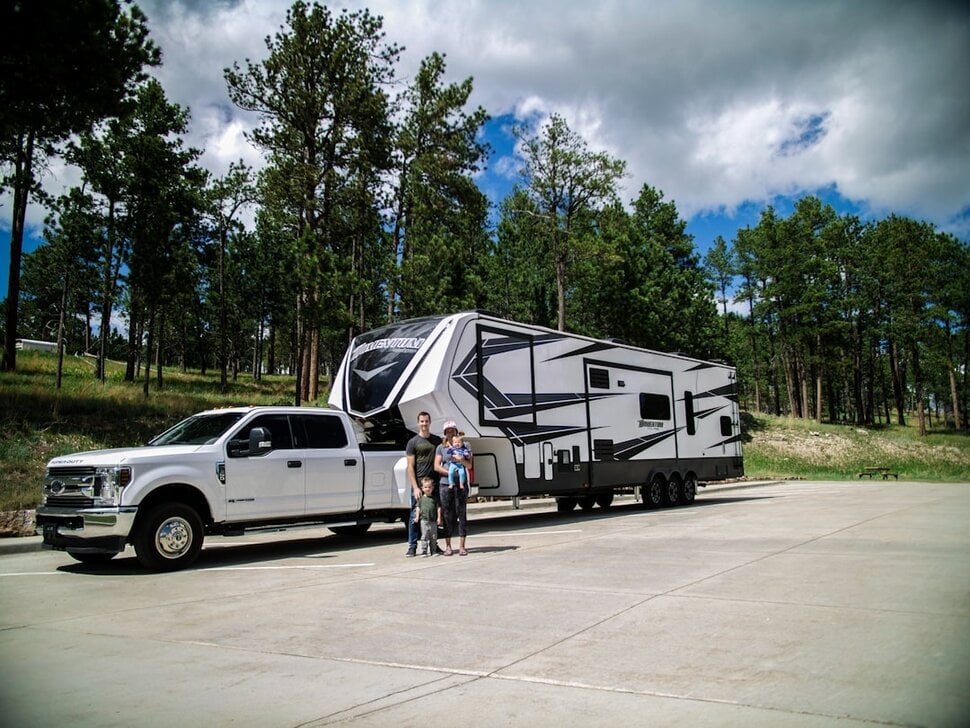
A fifth wheel hitch mounts in the bed of a pickup truck and connects to a kingpin on a special trailer, rather than through a hitch ball and coupler. The connection point is over or just forward of the rear axle instead of behind the bumper, which dramatically improves stability and turning radius for large trailers.
When a fifth wheel hitch is the right choice:
- You're towing a fifth-wheel trailer (the kind with the pin box that drops into the truck bed)
- Your trailer exceeds 10,000 lbs. or is tall and front-heavy
- You need the stability advantage at highway speeds on New Brunswick's longer drives
What to know about fifth wheel hitches:
Fifth wheel hitches are rated by GTW and pin weight (the downward force the trailer exerts on the hitch). The pin weight is typically 15–25% of the trailer's total weight, so a 15,000 lb. trailer puts 2,250–3,750 lbs. of pin weight on the hitch. That figure drives which hitch and which truck you need.
Installation requires either fixed rails bolted to the truck bed or a slider rail system (which lets the hitch slide back for tighter turning clearance in shorter-bed trucks). If you're driving a short-bed truck with a long fifth-wheel trailer, a slider hitch is almost always necessary to prevent the trailer from contacting the cab on sharp turns.
Weight Distribution Hitches: Keeping Things Level Under Load
A weight distribution hitch, also called a weight-distributing hitch, is not a replacement for a ball mount or fifth wheel. It works alongside a standard ball mount setup to redistribute tongue weight across all axles of the tow vehicle and trailer.
When a heavy trailer pushes down on the rear hitch ball, it lifts weight off the front axle of the tow vehicle. That front-axle lift reduces steering response and extends braking distances. A weight distribution hitch uses spring bars to transfer some of that tongue weight back to the front axle and forward trailer axles, keeping the entire rig level and improving control.
When a weight distribution hitch is the right choice:
- Your trailer's tongue weight exceeds 10–15% of your tow vehicle's rear axle rating
- The front of your tow vehicle rises noticeably when the trailer is hitched and loaded
- You're towing a travel trailer over 6,000 lbs. behind a half-ton or crossover
What to look for in a weight distribution setup:
Most weight distribution kits include the hitch head (which sits on the ball mount shank), the spring bars, and the sway control hardware. They're rated by tongue weight capacity. Match the kit's tongue weight rating to your trailer's tongue weight, not the total trailer weight.
Round bar systems are the most common and easiest to work with for most RV setups. Trunnion bar systems use a different bar geometry and tend to suit higher tongue weight applications.
Many manufacturers recommend weight distribution on any trailer over 6,000 lbs. towed by a half-ton truck, regardless of whether the front end is visibly lifting. The improvement in braking and handling is meaningful even when the sag isn't obvious.
Which Hitch Do You Actually Need?
Here's a straightforward decision path:
You have a fifth-wheel trailer with a pin box in the bed: a fifth-wheel hitch, full stop.
You have a standard travel trailer or utility trailer under 6,000 lbs.: a ball mount receiver hitch, Class III minimum, matched to your coupler size and drop.
You have a travel trailer over 6,000 lbs. behind a half-ton or crossover: ball mount receiver hitch plus a weight distribution kit. The weight distribution hitch attaches to the same receiver, adds the spring bar setup, and can include a sway control bar.
You have a travel trailer over 6,000 lbs. behind a 3/4-ton or 1-ton truck: ball mount receiver hitch, Class IV or V. Weight distribution is optional but still beneficial, particularly with sway control included.
When in doubt, check the numbers: your trailer's GVWR and tongue weight, your vehicle's tow rating and rear axle rating, and the hitch class your vehicle was designed to accept. Every component in the chain must be rated for the load; the weakest link sets the limit for the whole system.
Our guide to trailer couplers provides a deeper look at the trailer side of the equation, covering A-frame couplers, ball sizing, and coupler maintenance before the season starts.
Frequently asked questions
How do I know which trailer hitch class I need?
Start with your trailer's Gross Trailer Weight, the total loaded weight. Match it to a hitch class rated at or above that figure. For most travel trailers and camping setups in Atlantic Canada, a Class III (rated to 8,000 lbs.) or Class IV (rated to 12,000 lbs.) is appropriate. If your tow vehicle was built for a Class III receiver, don't exceed that class regardless of what the hitch hardware is rated for. The vehicle sets the ceiling.
What's the difference between a ball mount and a weight distribution hitch?
A ball mount holds the hitch ball and connects the trailer to the receiver hitch on your vehicle. A weight distribution hitch adds a spring bar system to the ball mount setup that redistributes tongue weight across the axles for better control. For trailers over about 6,000 lbs., the two are typically used together. The weight distribution head replaces the standard ball mount shank in your receiver, and the spring bars do the levelling work.
Do I need a weight distribution hitch for my travel trailer?
If your trailer's tongue weight causes the front of your tow vehicle to rise, the answer is yes. A general rule: if your tongue weight exceeds roughly 10–15% of your tow vehicle's rear axle rating, a weight distribution setup is worth it. Many half-ton truck owners find a weight distribution hitch makes a noticeable difference in braking and steering stability when pulling anything over 6,000 lbs. If you're not sure, bring your loaded trailer by and we can check how the vehicle is sitting; sometimes it takes just one trip to confirm.
Ready to match the right hitch to your rig? Stop in at 745 Route 133, Boudreau-Ouest, New Brunswick, or call us at (506) 532-5947. Our full towing setup, from receiver hitches and ball mounts to weight distribution systems and fifth wheel gear, is available in our shop.
Before your next trip, check our towing safety checklist to make sure your coupler, hitch hardware, and safety chains are all squared away.
Recent articles
View all
Scissor Jacks vs Stabilizer Jacks: Which Does Your Trailer Need?
5th Wheel & A-Frame Trailer Jacks Explained