5th Wheel & A-Frame Trailer Jacks Explained
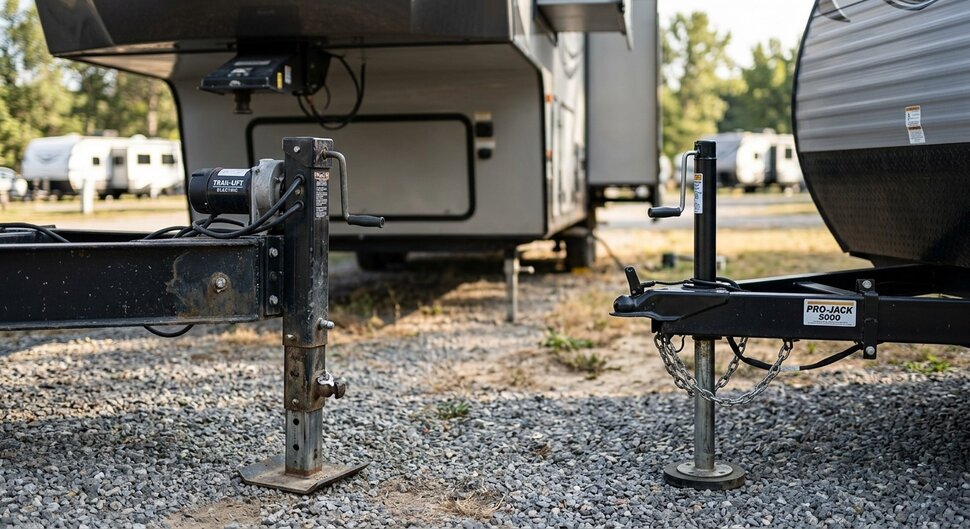
Not all trailer jacks do the same job, and the biggest split comes down to trailer type. A-frame trailers use a single tongue jack up front. 5th wheels use a landing gear system with two legs instead. Buy the wrong one and it either won't fit your trailer or won't handle the load correctly.
Here's how to tell which one your rig needs and what to look for once you know.
A-Frame Trailer Jacks: What They Do
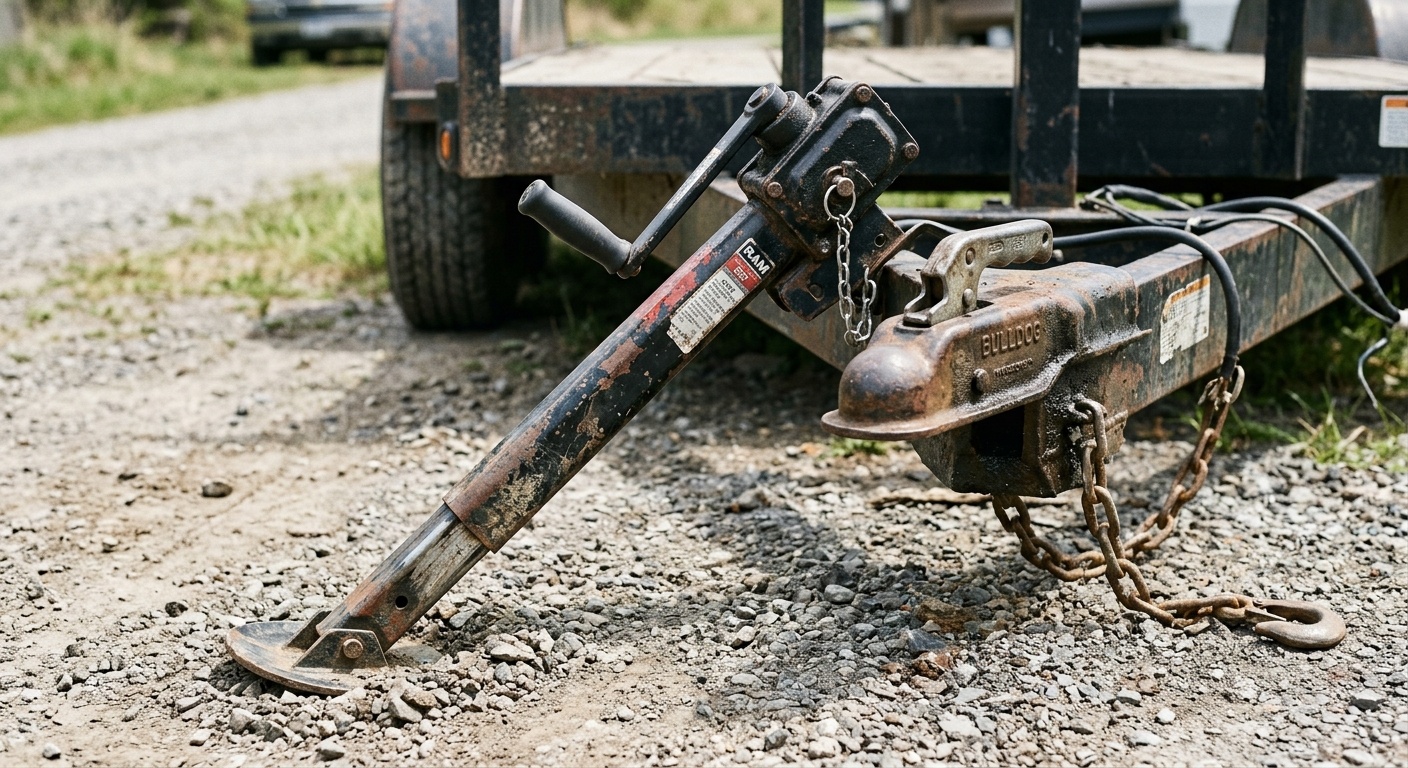
If you're towing a standard bumper-pull travel trailer, you've got an A-frame tongue up front, and that's where your jack mounts. A-frame jacks raise and lower the coupler to hitch and unhitch from your tow vehicle, and they support the tongue weight once you're parked and disconnected.
Manual jacks use a crank handle, top wind or side wind depending on the model, and they're the reliable, no-frills choice most trailer owners start with. Power jacks do the same lifting electrically, which is worth the upgrade if you're hitching and unhitching often, since a button beats cranking every time you head out.
5th Wheel Landing Gear: What They Do
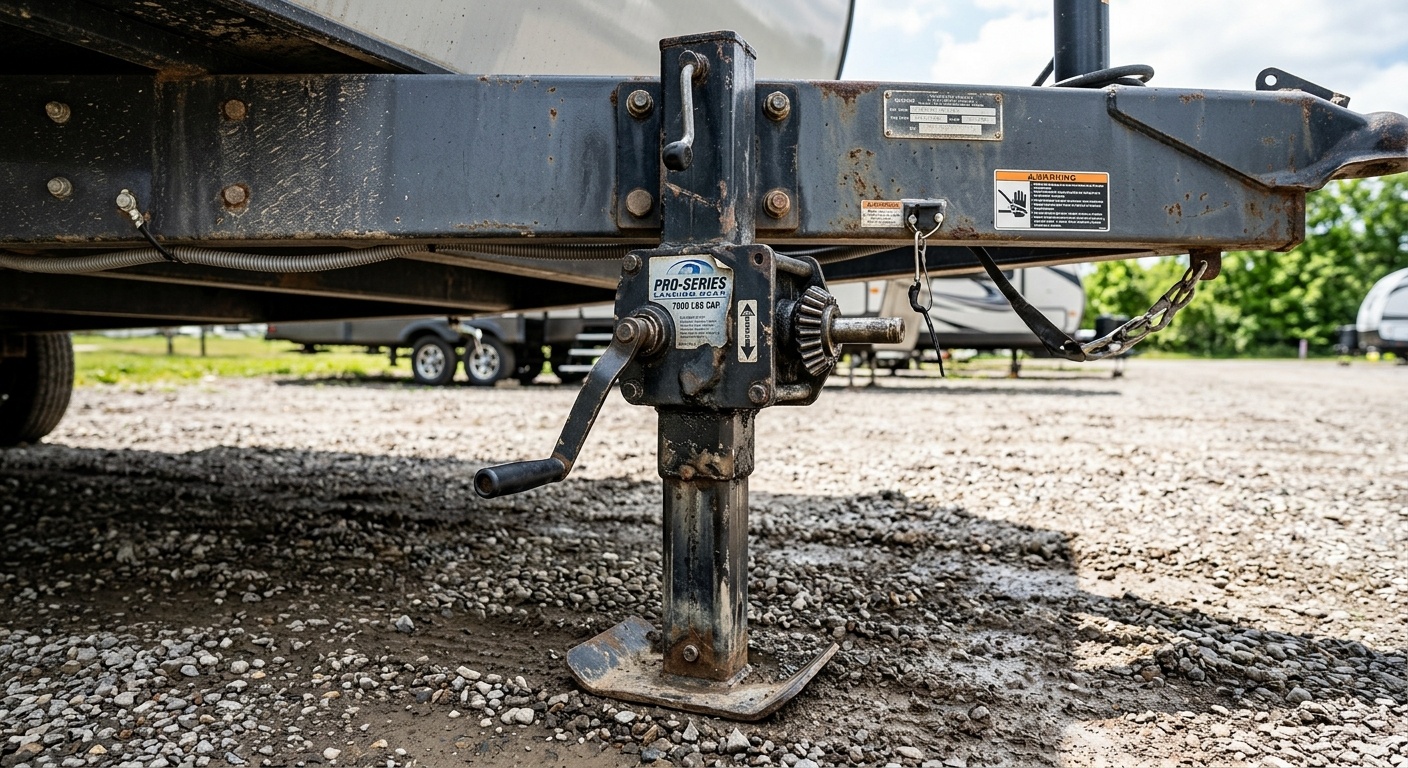
5th wheels don't have a single tongue up front, they have a king pin that connects to the hitch in your truck bed, and the trailer's weight up front needs a different kind of support once you're unhitched. That's where landing gear comes in: a pair of legs, one on each side, that lower down to hold the front of the trailer level and stable.
Fifth wheel landing legs work as a pair rather than a single unit, and they're designed for vertical loading straight down, not side-to-side stress. If you've got a 5th wheel with worn or seized landing gear, replacement legs are usually a straightforward swap rather than a full system replacement.
A-Frame Jacks vs 5th Wheel Landing Gear: Side by Side
|
A-Frame Jacks |
5th Wheel Landing Gear |
|
|---|---|---|
|
Trailer type |
Bumper-pull travel trailers, utility trailers |
5th wheel trailers |
|
Configuration |
Single jack at the tongue |
Pair of legs, front corners |
|
Operation |
Manual crank or electric power |
Manual crank or electric power |
|
Mount point |
A-frame tongue |
Frame near the king pin |
|
Typical upgrade path |
Manual to power tongue jack |
Manual to power landing gear |
Choosing the Right Capacity
Whichever type you're shopping for, the jack's rated capacity needs to clear your trailer's tongue weight with room to spare. Tongue weight typically runs 10 to 15 percent of your trailer's gross weight. A 5,000-pound travel trailer usually has a tongue weight somewhere between 500 and 750 pounds, so a jack rated comfortably above that, not right at the line, gives you a safety margin for uneven loading or a slightly heavier trailer down the road. The same logic applies to 5th wheel landing gear: check your trailer's front-end weight rating and buy legs rated above it, not at it.
Beyond capacity, a few smaller choices affect day-to-day use. A foot plate spreads the load and resists sinking into soft ground better than a bare jack foot. A wheel on the jack itself makes it easier to move a detached trailer by hand, useful for utility trailers you're maneuvering without a tow vehicle. None of these change the core job the jack does, but they're worth thinking about for your specific setup.
Frequently Asked Questions
Do I need landing gear or an A-frame jack?
It depends entirely on trailer type. A-frame travel trailers use a single tongue jack. 5th wheels use a pair of landing gear legs. There's no crossover between the two.
Can I upgrade from manual to power landing gear or a power tongue jack?
Yes, and it's one of the more popular upgrades for owners who hitch and unhitch frequently. Power versions mount similarly to manual ones, just with an electric motor and wiring added.
What size jack do I need for my trailer?
Match the jack's rated capacity to your trailer's tongue weight (roughly 10 to 15 percent of gross trailer weight), then buy a jack rated comfortably above that number rather than right at it.
How do I know if my 5th wheel landing gear needs replacing?
Seized, slow, or uneven operation between the two legs usually points to worn gearing or a failing motor on power units. Replacement legs are typically available without swapping the whole system.
Whether you're running an A-frame travel trailer or a 5th wheel, our manual jacks, power jacks, and fifth wheel landing legs are in stock and ready to ship, or stop in at 745 Route 133 in Boudreau-Ouest, and we'll help you match the right jack to your trailer and towing setup.
This wraps up our three-part series on RV leveling and jacks. Catch up on RV leveling basics and scissor jacks vs stabilizer jacks if you missed them.
Recent articles
View all
RV & BBQ Propane Regulators: Single-Stage vs Two-Stage