Self-Levelling vs. Non-Sag RV Lap Sealant: Which One Do You Need?
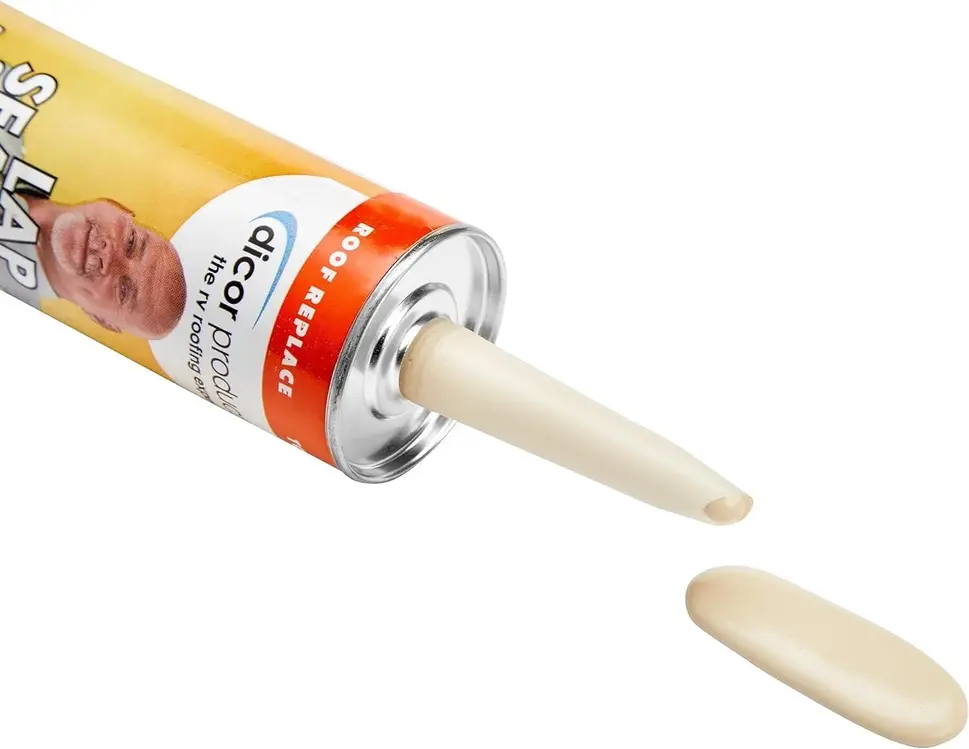
Picking the wrong lap sealant for the job is one of the most common RV roof mistakes, and it usually does not reveal itself until the repair fails a season later. Self-levelling sealant applied on a vertical surface runs and sags before it cures. Non-sag sealant forced onto a flat surface sits proud of the surrounding area and never quite seals the way it should. Neither failure is obvious at application time, but both let water in eventually.
The fix is straightforward once you understand what each product is actually designed to do. This guide breaks down the difference between self-levelling and non-sag RV lap sealant, walks through exactly where each one belongs on your trailer, and covers the specific products stocked at The Trailer Guys so you know what to buy before you get on the roof.
If you have not done a full roof inspection yet, start with our guide on how to inspect and seal your RV roof before camping season before deciding which sealant you need.
What is RV lap sealant and why does it matter
Lap sealant is the flexible, adhesive compound used to seal every point where a fixture, vent, screw head, or trim piece meets the roof membrane. It bridges the gap between two surfaces that expand and contract at different rates as temperature changes, keeping water out of the joint without cracking or losing adhesion.
It is not a general-purpose caulk. Standard household caulks are not formulated for the UV exposure, temperature swings, or roof membrane materials found on travel trailers and RVs. Using the wrong product results in adhesion failure, cracking, and water intrusion, often within a single season.
RV lap sealants are specifically engineered for EPDM rubber, TPO, fibreglass, aluminium, and other trailer roof materials. Within that category, the two main formulas, self-levelling and non-sag, are designed for different surface orientations, and choosing between them comes down to one question: is the surface you are sealing horizontal or vertical?
Self-levelling lap sealant: what it is and where to use it
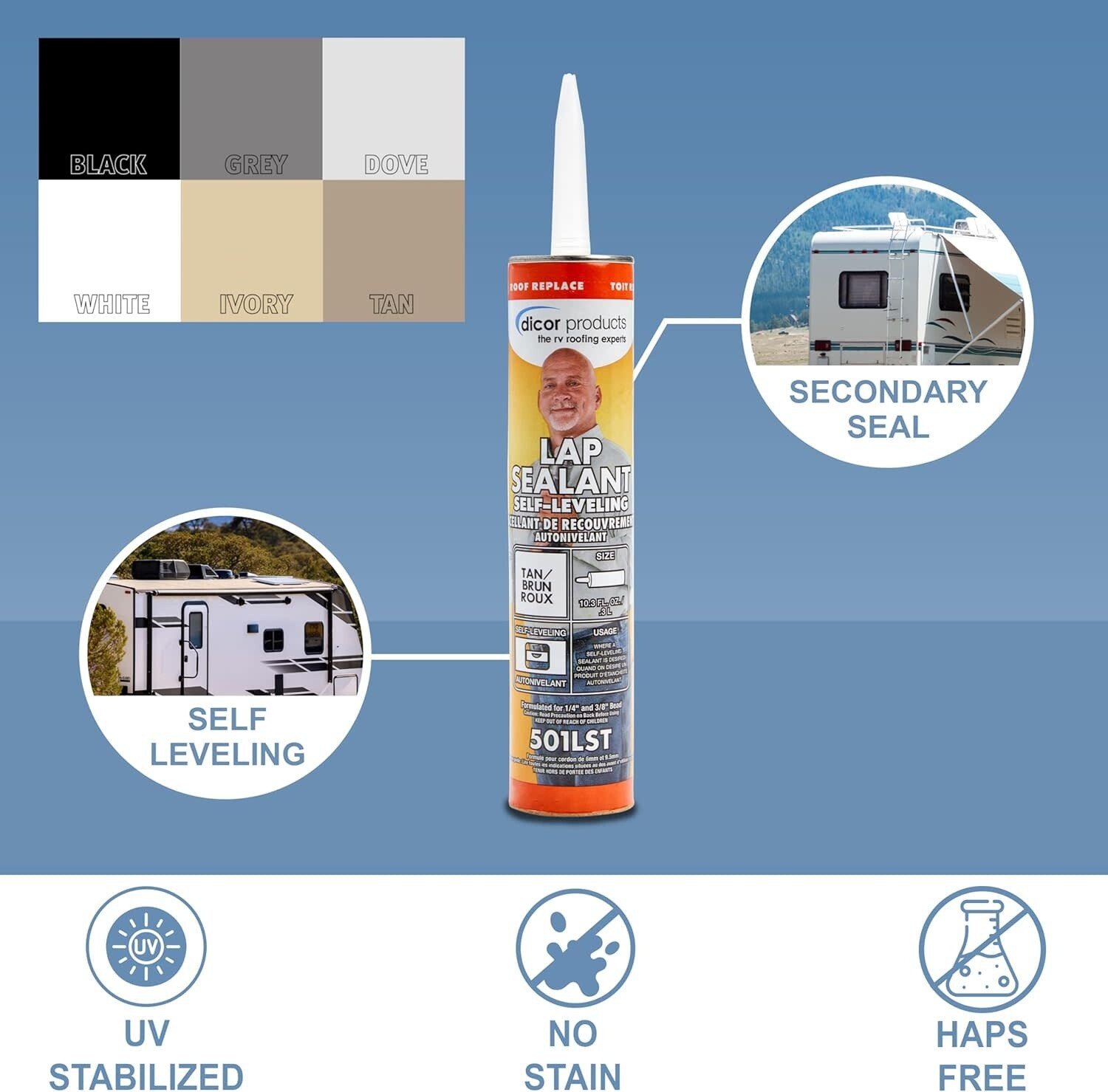
Self-levelling lap sealant is formulated with a consistency that allows it to flow slightly after application. When applied to a flat or near-flat surface, it settles into gaps, surrounds irregular shapes like screw heads and vent flanges, and levels itself out to create a smooth, continuous seal.
That flow is a feature, not a flaw. It is what allows self-levelling sealant to create full contact with the surface beneath it, including the small voids and surface irregularities that a stiffer product would bridge rather than fill. The result is a more complete seal with fewer gaps.
Use self-levelling sealant on:
- Screw heads and fasteners along roof seams
- The base flange of roof vents and fan housings, where the flange sits flat against the membrane
- Flat lap seam edges running along the roofline
- Antenna base plates and any flat-mounted fixture
Do not apply self-levelling sealant to:
- Vertical surfaces, sidewalls, or anywhere the product will be applied at an angle, as it will sag and run before curing
- Any surface where you need the sealant to hold a specific shape immediately after application
At The Trailer Guys, self-levelling lap sealant options include Dicor self-levelling in white and tan and Alpha Systems self-levelling in white and black. Dicor is formulated for EPDM and TPO. It is one of the most widely used lap sealants for roofs in the North American RV industry. The tan The option matches both beige and tan-coloured roofs, which matters if the appearance of the repairs is a concern. Browse the full roof sealants selection to see current stock.
Non-sag lap sealant: what it is and where to use it
Non-sag lap sealant has a thicker, stiffer consistency that holds its shape after application. It does not flow, which is precisely what you need when working on a vertical or angled surface where a self-levelling product would move out of position before it has a chance to cure.
The stiffer body also makes non-sag easier to tool and shape along edges, which gives you better control over the bead profile when working on irregular or complex surfaces.
Use non-sag sealant on:
- The vertical edges and sides of skylights and roof vents
- Any sidewall trim or corner where the sealant is applied vertically
- Angled surfaces such as the A-frame front cap of a travel trailer
- Areas where the sealant needs to be shaped or tooled into a specific profile
- Vertical joints where the roof membrane meets a wall or fascia
Do not use non-sag sealant on:
- Flat horizontal surfaces like screw fields and vent flanges, where the thicker consistency prevents it from fully conforming to the surface and filling gaps completely
Non-sag options at The Trailer Guys include Dicor non-sag in white and Alpha Systems non-sag in both white and black. The black options are useful for trailers with dark trim or when sealing around black-framed skylights or tinted roof fixtures where a white bead would be visually obvious.
A quick reference: which sealant for which surface
| Surface | Sealant type | Why |
| Screw heads along roof seams | Self-levelling | Flows around irregular shapes for full contact |
| Roof vent base flange (flat) | Self-levelling | Settles into surface irregularities |
| AC unit base (flat to roof) | Self-levelling | Large flat contact area benefits from flow |
| Vertical skylight edges | Non-sag | Holds position on vertical surface |
| Sidewall trim and corner joints | Non-sag | Will not run before curing |
| Angled front cap seams | Non-sag | Thicker body stays where applied |
| Flat lap seam edges | Self-levelling | Levels out for a smooth, continuous seal |

Does roof material change which sealant you use?
The self-levelling versus non-sag decision is based on surface orientation, not roof material. However, your roof material does determine which brand and formula you should buy within each type.
For EPDM rubber roofs, use Dicor or Alpha Systems lap sealants. Both are formulated specifically for EPDM compatibility and will bond correctly to the membrane without causing degradation.
For TPO roofs, Dicor lap sealant is also compatible with TPO. For larger repair areas on TPO, Sika Multiseal Plus roof tape from our collection is a strong companion product that bonds directly to the TPO membrane and works well alongside lap sealant at penetrations.
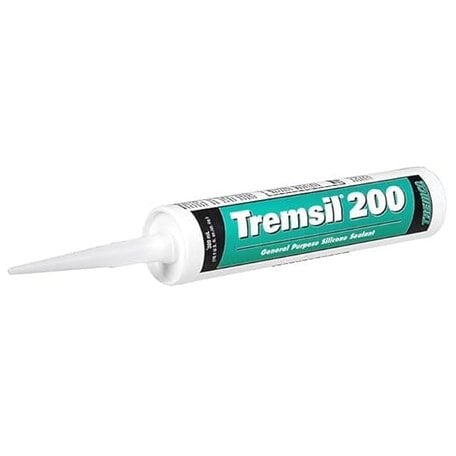
For fibreglass roofs, Dicor lap sealant works well on fibreglass surfaces for sealing roof penetrations, screw heads, and seams. TremPro 645 white silicone is the better choice for the vertical walls around the trailer, mouldings, vents, doors, and windows, where silicone handles those surface types and movement characteristics more effectively.
For PVC roofs, Dicor lap sealant is also compatible and can be used for sealing penetrations, seams, and screw heads in the same way as on EPDM and TPO surfaces.
If you are unsure of your trailer's roof material, review the roof type identification section earlier in this guide before buying.
How to apply RV lap sealant correctly
Getting the product right is only half the job. Poor application technique accounts for a significant share of sealant failures, regardless of which formula you use.
Surface preparation is the most important step. Sealant applied over old cracked caulk, dirty membrane, or damp surfaces will not bond correctly. Remove all old sealant with a plastic scraper, never a metal blade on rubber or TPO, and clean the area with a rubber roof cleaner or rubbing alcohol. Let it dry fully before applying anything.
Cut the tube tip at a 45-degree angle to give yourself control over the bead width. A smaller opening gives a narrower, more precise bead. For most screw heads and vent flanges, a bead width of roughly half an inch to three-quarters of an inch provides adequate coverage.
Apply in one continuous motion without stopping mid-bead if possible. Stops and starts creating thin spots that are the first places to fail.
Tool the bead smooth immediately after application using a wet finger or a plastic caulk tool. The goal is full contact between the sealant and both surfaces it is bridging, with no gaps or air pockets along the edges.
Allow full cure time before rain exposure. Both Dicor and Alpha Systems products need 24 to 48 hours to cure adequately. Check the forecast before starting the job.
What about sidewall and exterior caulking?
Lap sealant handles the roof, but the exterior sidewalls of your trailer have their own sealing needs. Window frames, door frames, exterior light fixtures, and trim pieces all require caulking that is appropriate for vertical exterior surfaces. Browse the outside wall caulking section at The Trailer Guys for sidewall-specific products.
How often should lap sealant be replaced?
Under normal conditions and with correct application, a durable lap sealant will last two to four years before it needs attention. In Atlantic Canada, UV load, temperature cycling, and the physical flexing that happens during highway travel all shorten that timeline compared to milder climates.
The practical answer is to inspect every bead annually. Spring is the right time to catch anything that degraded over winter. If a bead feels stiff, shows surface cracking, or has lifted away from either surface at any point along its length, replace it before the camping season begins.
Frequently asked questions
Can I use self-levelling sealant on a vertical surface if I apply it carefully?
No. The flow properties of self-levelling sealant are inherent to the formula and are not controllable through application technique. Even a careful, minimal application will sag on a vertical surface before it cures. Use non-sag on any surface that is not flat or near-flat.
Can I mix brands, for example, Dicor in one area and Alpha Systems in another?
Yes. Dicor and Alpha Systems are both EPDM-compatible lap sealants and can be used on different areas of the same roof without compatibility issues. Just make sure you are matching the formula type to the surface orientation regardless of which brand you choose.
My sealant is a different colour than my roof. Does it need to match?
Functionally, no. White sealant on a white roof and tan sealant on a tan roof are aesthetic choices; the seal's performance is the same regardless of colour. If appearance matters to you, Dicor's tan self-levelling option is the right pick for beige- and tan-coloured roofs.
How much sealant do I need for a full roof reseal?
It depends on how many penetrations your roof has and the condition of the existing sealant. A typical travel trailer with standard vents, an AC unit, and an antenna will use two to four tubes for a complete reseal of all penetrations. Buy an extra tube when you start.
Where can I buy RV lap sealant in Atlantic Canada?
The Trailer Guys stock Dicor self-levelling and non-sag, Alpha Systems self-levelling and non-sag, and TremPro silicone sealant at their location at 745 Route 133, Boudreau Ouest, New Brunswick. All products ship across Canada. Browse the full RV roof maintenance collection or contact the team by phone or text if you want to confirm which product is right for your specific roof before ordering.
Recent articles
View all
Scissor Jacks vs Stabilizer Jacks: Which Does Your Trailer Need?
5th Wheel & A-Frame Trailer Jacks Explained